
What is eco-printing?
Eco-printing is a botanical dyeing technique that captures the natural shapes, colours, and pigments of plants directly onto fabric. The process begins by gathering leaves, flowers, bark, and seeds - seasonal or locally foraged - and placing them onto pre-prepared (scoured and mordanted) natural fibres such as silk, wool, cotton or linen.
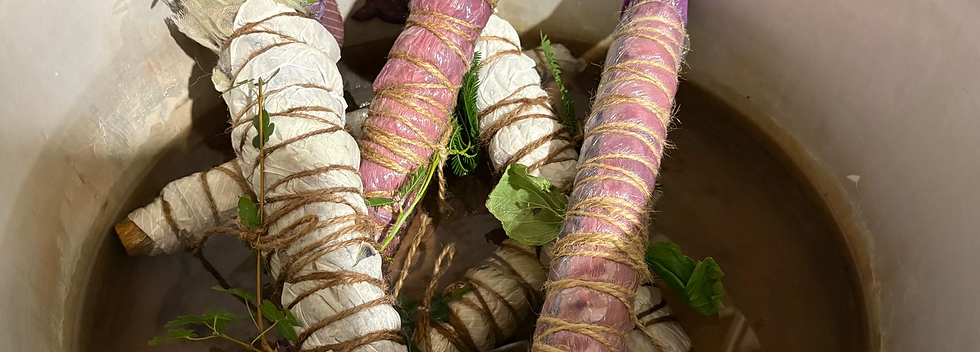
The fabric is then tightly bundled, bound, and subjected to heat or steam, allowing the plant’s natural dyes and tannins to transfer into and onto the cloth. This creates unique, often intricate imprints that reflect the plant’s original form and/or pigment. Because no two leaves or flowers are exactly alike, each piece is completely one-of-a-kind.
Although its precise origins are difficult to pinpoint, eco-printing draws on centuries-old plant-dyeing traditions from cultures around the world, including Japan’s katazome, India’s block printing and natural dyeing, and Europe’s long history of botanical dye use. What makes eco-printing distinct from other natural dyeing methods is that it records the actual botanical imprint - not just the colour - of the plant on the cloth.
In recent years, eco-printing has experienced a creative revival, thanks in large part to Australian artist Irit Dulman. Her innovative work - combining plant-based prints with contemporary textile design - has inspired a global community of makers and reignited interest in the craft. Today, eco-printing is valued not only for its aesthetic beauty but also for its sustainability, as it uses renewable materials, promotes up-cycling and often incorporates waste plant matter, and avoids harmful synthetic dyes.
Eco-printing is a slow, intentional process. It requires knowledge of plants and their dye properties, careful fabric preparation, and a willingness to embrace the unpredictability of working with nature. No two prints will ever be the same, and it doesn't work every time!


